Efficient Resource Utilization
การใช้ทรัพยากรอย่างมีประสิทธิภาพ
We prioritize energy efficiency to support sustainable business operations by encouraging employees at all levels to participate in energy reduction initiatives. We have established energy management measures covering office buildings and various equipment.
Electricity Management
Air Conditioning System Management
- Set temperature at 25°C for optimal comfort and energy savings
- Control on-off schedules to align with working hours
- Regular inspection and maintenance, such as cleaning air filters at least once a month
Lighting System Management
- Turn lights on-off as needed, using only in occupied areas
- Promote natural lighting to reduce electricity consumption
- Maintain lighting equipment every 3-6 months to preserve efficiency
Office Equipment Management
- Computers: Set power-saving mode when inactive for more than 10 minutes
- Printers: Share appropriately and turn off when not in use
- Electric Kettles: Use only when necessary and unplug after use
- Refrigerators: Position ≥ 15 cm from walls and minimize unnecessary opening
- Elevators: Encourage stair use for short distances and share elevator rides to reduce energy
Performance Results
In 2025, the company used a total of 813,000 kWh of electricity, an increase of 32.49% from 2024. This increase aligns with business expansion activities and improvements in data collection scope for more comprehensive coverage.
Factors Affecting Electricity Usage
Increased Training Activities
Increased by 15.6%, resulting in higher building energy consumption
Seminars and Space Usage
1,211 participants attended seminars, affecting overall energy consumption
Expanded Reporting Scope
Now covers Distribution Center and R&D, providing more complete energy usage data
Company Electricity Usage and Contributing Factors
| Company Electricity Usage | 2023 | 2024 | 2025 |
|---|---|---|---|
| Total Electricity Usage (kWh) | 603,591 | 613,635 | 813,000 |
| Purchased Electricity (kWh) | 523,000 | 534,000 | 736,900 |
| Renewable Energy Electricity | 80,591 | 79,635 | 76,100 |
| Factors Affecting Company Electricity Usage | |||
| In-house Training Activities (Hours) | 150 | 165.75 | 191.90 |
| Total Electricity Usage (kWh per Activity Hour) | 4,023.94 | 3,702.17 | 4,236.58 |
| Number of Seminar Attendees (Persons) | 2,710 | 2,995 | 1,211 |
Renewable Energy (Solar Rooftop)
The company has installed a solar power generation system (Solar Rooftop On-Grid) with a capacity of 57.4 kW since 2020 at the main office building to increase the proportion of clean energy usage and reduce greenhouse gas emissions.
Solar Roof Top On-Grid 57.4 KW Electricity Production (Unit: kWh)
| Electricity Production | 2023 | 2024 | 2025 |
|---|---|---|---|
| Solar Roof Top On-Grid Electricity Production | 80,591 | 79,635 | 76,100 |
Fuel Energy Management
The company prioritizes fuel energy management in transportation and operations, aiming to reduce dependence on fossil fuels and decrease greenhouse gas emissions from logistics activities.
The company has developed operational approaches focusing on improving energy efficiency while adopting environmentally friendly technologies to enhance sustainable transportation.
Transition to Electric Vehicles (EV)
- Gradually transitioning vehicles from internal combustion engines to Electric Vehicles (EV)
- Reducing fossil fuel consumption and supporting greenhouse gas emission reduction
Transportation Route Management
- Planning efficient transportation routes (Route Optimization)
- Consolidating routes and sequencing deliveries to reduce unnecessary distances
- Reducing fuel consumption and improving logistics efficiency
Promoting Energy Efficiency
- Campaigning to avoid engine idling while parked (Idling Reduction)
- Regular vehicle inspection and maintenance
- Planning vehicle usage appropriate to work requirements
- Promoting energy-saving driving behaviors
Water Resource Management
We are committed to promoting responsible water use within the organization, while raising employee awareness to participate in water conservation.
The company continuously improves water systems within buildings, monitors and evaluates water usage to enhance resource efficiency, reduce unnecessary water consumption, and minimize long-term environmental impact.
Water Conservation
- Promoting water use based on 3Rs principles (Reduce, Reuse, Recycle)
- Adjusting faucet flow rates to reduce unnecessary water use
- Reducing water volume in sanitary systems such as toilets
- Continuously campaigning to build water conservation awareness among employees
Water Recycling
- Used water undergoes preliminary treatment processes
- Recycled for appropriate activities within the organization
- Reducing tap water dependency and improving water resource efficiency
Water Reuse
- Reusing water of suitable quality for various activities
- Using treated water for watering organic vegetable gardens
- Implementing Rainwater Harvesting projects for cleaning and plant watering
Bottled Water Reduction Initiative
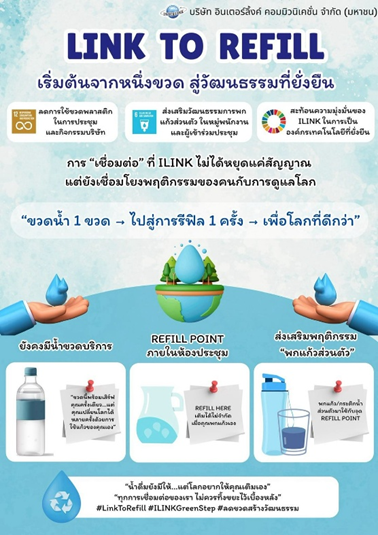
- Implementing the "LINK to Refill" project
- Promoting personal water bottle use and refilling at service points
- Reducing single-use plastic, piloting in meeting activities
Performance Results
In 2025, the company used a total of 6,448 cubic meters of water, an increase of 86.84% from 2024. This change is mainly due to business activity expansion and improvements in data collection coverage.
Factors Affecting Water Usage
The increase in water usage in 2025 has the following key reasons:
Increased Internal Training
Increased by 15.6%, resulting in higher on-site water usage
Seminars and Space Usage
1,211 participants attended seminars with related water usage
Expanded Data Collection
Now covers Distribution Center and R&D, significantly increasing total water usage data
Company Water Usage and Contributing Factors
| Company Water Usage | 2023 | 2024 | 2025 |
|---|---|---|---|
| Total Water Usage (Cubic Meters - Year) | 3,070 | 3,451 | 6,448 |
| Factors Affecting Company Water Usage | |||
| In-house Training Activities (Hours) | 150 | 165.75 | 191.90 |
| Total Water Usage (Cubic Meters per Activity Hour) | 20.47 | 20.82 | 33.60 |
| Number of Seminar Attendees (Persons) | 2,710 | 2,995 | 1,211 |
Waste Management
INTERLINK aims to reduce environmental, social, and community impact through waste reduction at source, proper sorting, and maximizing resource utilization.
The company promotes employee participation while continuously fostering environmental awareness and operating under the Circular Economy concept.
Reduce
Resource Reduction at Source
- Using E-Slip system instead of paper documents
- Promoting double-sided printing and reducing unnecessary printing
- Supporting Paperless Office through digital systems
Reuse
Reusing Items
- Using both sides of paper before disposal
- Reusing document envelopes within the organization
- Collecting usable office equipment for reuse or donation
Recycle
Recycling Materials
- Setting up waste sorting stations for paper, plastic, glass, and metal in offices and warehouses
- Promoting recyclable or recycled-material products
- Implementing "Mommam Collection Box" project for plastic bottle collection and recycling